Status: October 2026
A Learning Management System (LMS) helps small and medium-sized enterprises organize employee training, onboarding, and continuing education digitally. But which LMS fits your requirements? SMEs with around 10 to 250 employees, in particular, need a learning platform that is easy to implement and manage without requiring extensive IT resources.
In this comparison, we present 17 LMS providers and show which solutions are suitable for different company sizes, training requirements, and deployment scenarios. You will also learn what to look for regarding features, costs, support, and data privacy.
Note: The providers are listed in alphabetical order. The sequence does not represent an evaluation or ranking.
What must an LMS deliver for SMEs?
Above all, an LMS for small and medium-sized enterprises must fit the available resources within your team and the training requirements of your company. SMEs do not necessarily need fewer features than large enterprises: the decisive factor is that the learning platform can be easily used in everyday work and operated with reasonable effort.
How easy is it to implement an LMS without an in-house IT department?
Many SMEs do not have an in-house IT department or have only limited technical capacity. Therefore, an LMS should be as straightforward to set up as possible and easy to operate even without extensive IT skills. Pay particular attention to the following points:
Easy setup: Cloud-based learning platforms can often be used directly in the browser, without dedicated servers or complex installations.
Intuitive operation: Creating courses, managing employees, and checking learning progress should be possible without specialized technical expertise. Course participants should also be able to find their way around the learning platform right away without time-consuming training.
Low administrative effort: Automated course assignments, reminders, and recurring training sessions facilitate administration.
Personal support: German-speaking contacts should provide assistance with onboarding, training projects, and technical questions.
How can diverse employee groups be trained digitally?
Not all employees work at a computer daily or have a corporate email address. Especially in manufacturing, field service, skilled trades, or service companies, digital learning must therefore be flexibly accessible.
Mobile use: Training should also work smoothly on smartphones and tablets.
Flexible access options: Depending on the employee structure, login options without a personal email address may be important.
Multilingual learning options: Employees with different language backgrounds benefit from learning content in their respective languages.
Diverse learning formats: Self-paced courses, videos, quizzes, and blended learning enable training for different departments and learning needs.
Which features do SMEs need for their training?
The required scope of features depends on the type of training your company wants to conduct. For onboarding, professional development, mandatory compliance training, and product training, these LMS features are particularly relevant:
Course creation: Create custom learning content, integrate existing materials, and leverage AI features if needed.
User management: Organize employees into groups, assign roles, and allocate courses targetedly.
Automations: Efficiently manage recurring training sessions, reminders, and course releases.
Learning progress and reports: Track participation, completion status, and learning outcomes.
Certificates and records: Document successfully completed training and provide employees with personal proof of qualification.
What role do data privacy and technical requirements play?
Even smaller companies must pay attention to data privacy and data security when implementing an LMS. Because learning platforms process personal data of employees, customers, and other training participants, these criteria should be evaluated when choosing an LMS:
GDPR compliance: Data privacy requirements and the option to conclude a Data Processing Agreement (DPA).
Hosting and data security: Server location, technical safeguards, and relevant security certifications of the LMS provider.
Access rights: Ensure that employees and administrators can only access their designated data and features.
Technical integrations: Verify whether the LMS can connect with existing HR systems or other enterprise applications if needed.
17 Learning Management Systems for SMEs in Comparison
For this comparison, we selected 17 LMS providers that cover diverse requirements of small and medium-sized enterprises. The selection criteria included SME suitability, availability in the DACH region, the ability to create and manage custom courses, and transparent product information.
For each provider, we focus on the features and key use cases that are especially relevant for SMEs. Therefore, the highlighted strengths are not exhaustive feature lists. Providers may offer additional features beyond those explicitly listed in this comparison.
The following overview provides initial guidance. Afterwards, we present all 17 learning platforms in greater detail.
You can find an overview of Learning Management Systems for companies of various sizes and requirements in our general LMS comparison.
PROVIDER | PARTICULARLY SUITED FOR | STRENGTHS FOR SMES |
blink.it | SMEs with proprietary digital training and onboarding programs | Simple course creation, AI features, automations |
Easy LMS | SMEs with examination and certification needs | Online exams, knowledge quizzes, certificates |
elearnio | SMEs with structured onboarding processes | Preboarding, role-based onboarding, training plans |
eloomi | SMEs with systematic personnel development | Skills management, learning paths, development plans |
Evalea | SMEs with diverse training and HR processes | Modular LMS, seminar management, HR processes |
Haufe Akademie LMS | Medium-sized businesses with extensive continuing education needs | Custom courses, ready-to-use learning content, consulting |
hiveQ | SMEs with customized and international training requirements | Skills management, multilingualism, external training |
iPrendo | SMEs with diverse exams and flexible access options | 19 question types, AI course creation, access codes |
keelearning | SMEs with mobile employees without dedicated PC workstations | Mobile learning without email, multilingual onboarding |
Knowledgeworker | SMEs with sophisticated in-house course creation needs | Interactive e-learning, collaborative content creation |
LENA | SMEs with mobile teams and regular mandatory briefing needs | Mobile training, briefing certificates, AI translations |
Litmos | Larger SMEs with extensive internal and external training programs | Course library, compliance, integrations |
reteach | SMEs with automated mandatory training | Compliance workflows, training records, course catalog |
skillsforwork | SMEs with mandatory training and industry-specific requirements | Ready-made specialist content, occupational safety, training records |
TalentLMS | SMEs with distributed teams and varied target groups | Separate learning portals, mobile use, course library |
TUTORize | SMEs with high documentation and qualification standards | Mandatory training, audit-ready records, knowledge management |
UNIVADO LMS | SMEs with regular mandatory training and support needs | Expert-verified content, update service, dedicated support |
blink.it
blink.it is a cloud-based LMS from Germany with a focus on simple course creation and straightforward training administration. The learning platform supports SMEs in implementing digital training and blended learning without requiring extensive IT expertise.
Key strengths for SMEs:
Easy operation and setup: Intuitive user interface for administrators and learners, directly in the browser without local installation.
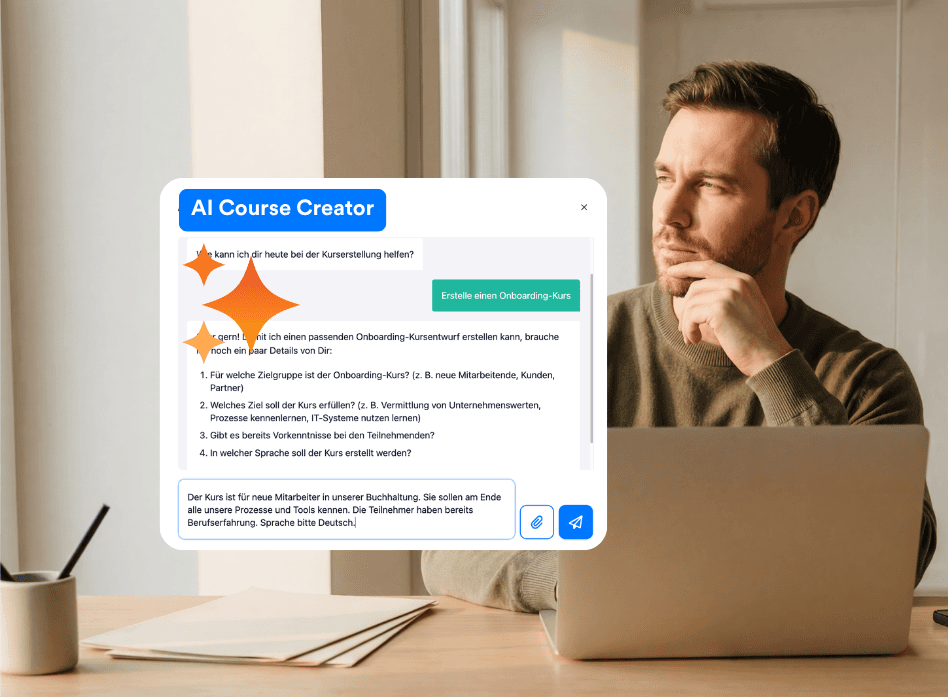
AI-powered course creation: AI Course Creator and AI Quiz Generator assist with course structures, learning content, and quiz questions.
Flexible learning formats: Combine self-paced courses, videos, quizzes, and blended learning for diverse training requirements.
Automations: Recurring training sessions, reminders, and course releases reduce administrative effort.
Personal support: German-speaking support, help center, onboarding for the learning platform, and guidance on training projects.
👍 Especially suitable for SMEs that want to easily create, organize, and manage their own digital training and blended learning. (Note: blink.it is the provider of this blog.)
Easy LMS
Easy LMS is a cloud-based Learning Management System from the Netherlands focused on online exams, knowledge assessments, and certification. The learning platform enables SMEs to create their own training and tests, provide them centrally, and document learning outcomes.
Key strengths for SMEs:
Simple course creation: Create custom online courses with text, images, videos, and audio files, and embed existing training materials.
Flexible online exams: Design knowledge tests with different question types, custom grading criteria, and passing thresholds.
Certificates: Automatically issue customizable certificates upon successful completion of courses or exams and document training accomplishments.
Central learning environment: Bundle courses and exams in an academy and manage participant groups clearly.
Reporting and administration: Monitor exam results, pass rates, and learning progress, and export reports.
👍 Particularly suitable for SMEs looking to combine employee training with structured knowledge assessments, certifications, and verifiable learning outcomes.
elearnio
elearnio is a cloud-based LMS from Germany with a focus on structured preboarding, onboarding, and role-based employee development. The learning platform helps SMEs centrally organize onboarding and training processes.
Key strengths for SMEs:
Tailored training plans: Combine digital courses, live sessions, and milestones into structured onboarding paths.
Integrated authoring tool with AI: Create custom interactive courses and quizzes, optionally supported by an AI generator.
Role-based learning workflows: Tailor training content and onboarding plans to specific roles and employee groups.
HR integrations: Connect with Personio and other HR systems to link employee data with training workflows.
👍 Especially suitable for SMEs that want to systematically onboard new hires and standardize individualized onboarding workflows.
eloomi
eloomi is a cloud-based LMS from Denmark that combines employee training with skills management and talent development. The learning platform helps SMEs align continuing education with their employees' skills and professional growth goals.
Key strengths for SMEs:
Skills management: Track employee competencies and derive targeted training initiatives from identified skill gaps.
Personalized learning paths: Curate training based on job profiles, competencies, and individual development goals.
Integrated authoring tool: Build custom courses using a drag-and-drop editor and integrate existing learning content like videos, PDFs, and SCORM files.
Comprehensive course library: Access a wide array of ready-to-use content covering compliance, leadership, professional skills, and other topics.
Personnel development: Link learning objectives with 1-on-1 performance reviews, appraisals, and individualized development plans.
👍 Especially suitable for SMEs that, in addition to standard employee training, want to systematically develop competencies and promote long-term staff development.
Evalea
Evalea is a modular learning platform from Germany that connects e-learning, seminar management, and internal HR development. It enables SMEs to organize diverse continuing education processes centrally and assemble the required features flexibly.
Key strengths for SMEs:
Modular architecture: Eight freely combinable modules allow for a needs-based start and seamless expansion later on.
E-learning with AI: Create custom online courses via authoring tool or AI, import existing SCORM packages, and access pre-built learning content.
Seminar management: Organize classroom training and workshops with registration handling, approval workflows, and attendee management.
Learning journeys: Support learners before, during, and after training with digital learning nudges and reflective prompts.
Integrated HR processes: Incorporate employee appraisals, competency assessments, target agreements, and feedback into workforce development.
👍 Particularly suitable for SMEs looking to link e-learning and traditional training with other HR processes and flexibly expand their platform scope.
Haufe Akademie LMS
The Haufe Akademie LMS is a cloud-based learning platform that combines workplace learning, custom course creation, and ready-made learning content. As part of the Haufe Digital Suite, it offers mid-sized enterprises diverse options for centrally organizing and scaling their training processes.
Key strengths for SMEs:
Learning platform and content from a single source: The LMS can be paired with Haufe Akademie’s e-learning courses, microlearning modules, and compliance offerings.
Integrated authoring tool: Create digital learning content in-house and prepare existing training materials for different target groups.
Event management: Centrally plan and manage in-person training sessions, webinars, participants, and instructors.
AI support: AI capabilities assist with content creation, translations, and administrative tasks, among other features.
Consulting and support: Advisory support for the introduction, design, and continued evolution of corporate learning offerings.
👍 Particularly suited for medium-sized companies with extensive training needs that want custom training, turnkey learning content, and accompanying consulting from a single source.
hiveQ
hiveQ is an LMS from Switzerland that combines flexible learning workflows, skills management, and bespoke customization options. The platform is well-suited for SMEs with diverse training requirements and also supports the training of external partners and customers.
Key strengths for SMEs:
Skill and competency management: Track capabilities in a skill matrix, identify competency gaps, and assign suitable training.
Custom learning paths: Combine online courses, classroom training, and interactive elements into structured learning journeys with milestones.
AI-powered course creation: The built-in authoring tool AI•bee supports the creation of learning content.
Multilingual training: Benefit from user interfaces in over 46 languages and AI translations of course content for international teams.
Partner and customer training: Train external target groups in dedicated portals and optionally monetize courses via integrated e-commerce features.
👍 Particularly suited for SMEs with customized learning processes, an international workforce, or external training audiences that require a highly adaptable platform.
iPrendo
iPrendo is a cloud-based LMS from Germany that combines interactive course creation, diverse testing formats, and flexible participant access options. The platform supports SMEs in implementing in-house training with varied learning and testing requirements.
Key strengths for SMEs:
Diverse testing formats: Develop quizzes and knowledge assessments using 19 different question types tailored to various learning goals.
AI-powered course creation: An AI editor and AI quiz generator assist with developing custom learning content and test questions.
Flexible learner access: Self-registration and access codes simplify course rollouts for changing participant groups.
Custom configuration: Enable or disable features as needed and expand the platform with capabilities such as webinars or coupon codes.
👍 Particularly suitable for SMEs looking to deliver interactive training with versatile exam formats and flexible participant access.
keelearning
keelearning is a German LMS specialized in mobile employee training and upskilling frontline workers. The learning platform helps SMEs digitally train employees who do not have a fixed desk or a company email address.
Key strengths for SMEs:
Mobile learning without an email address: Staff can access training via smartphone or tablet without needing a business email address.
Multilingual onboarding: Onboard new hires with learning content in various languages to eliminate language barriers.
Course templates and learning content: Utilize pre-designed training templates and customize them with proprietary content for specific operational needs.
Team knowledge exchange: Employees can share experiences, tips, and practical knowledge to learn from one another.
👍 Especially suitable for SMEs with mobile staff, rotating work locations, or deskless teams who want to organize training and knowledge sharing without friction.
Knowledgeworker
Knowledgeworker is an e-learning software suite from Germany that combines professional course creation with a streamlined learning platform. SMEs can create interactive learning content using Knowledgeworker Create and distribute and manage it via the Knowledgeworker Share LMS.
Key strengths for SMEs:
Professional authoring tool: Create interactive online courses with diverse design elements and publish them as SCORM or HTML packages.
AI-powered content creation: The AI assistant KAI supports course outlines, copy, quiz questions, and translations.
Reusable learning assets: Store content centrally, repurpose it across multiple courses, and propagate updates automatically.
Collaborative course authoring: Coordinate tasks, reviews, and sign-offs directly inside the authoring tool to facilitate collaborative content development.
Scenario-based learning: Design interactive dialogues and realistic practice scenarios for communication and soft skills using Knowledgeworker Coach.
👍 Particularly suitable for SMEs looking to develop, co-edit, and maintain their own interactive e-learning modules over the long term.
LENA
LENA is an LMS from Austria specializing in mobile employee training, digital mandatory briefings, and multilingual learning offerings. The platform helps SMEs deliver and reliably document training for employees across distributed workplaces.
Key strengths for SMEs:
Mobile training: Train deskless employees via the LENA app and reach them directly with push notifications.
Digital briefing records: Document training completions using digitally signed, tamper-proof certificates.
AI-powered course creation: Convert existing training documents into digital learning content using AI and refine courses in the editor.
Multilingual training: Translate learning content and tests into over 45 languages with AI to lower language barriers.
Training matrix: Plan mandatory compliance sessions by employee groups, skills, and renewal intervals, and monitor their status.
👍 Particularly suitable for SMEs with mobile teams, a multilingual workforce, and regular safety briefing requirements, such as in production, trades, or service sectors.
Litmos
Litmos is an internationally oriented, cloud-based LMS for larger SMEs with multifaceted training needs. The platform brings together employee training, compliance management, and education for external target audiences.
Key strengths for SMEs:
Extensive course libraries: Access thousands of ready-made learning modules covering compliance, workplace safety, leadership, and other topics.
AI-powered course creation: Generate custom courses and knowledge checks with AI and refresh existing content.
Compliance management: Assign mandatory courses, track certificate expiration dates, and maintain documentation for audits.
Customer and partner training: Train external target groups in dedicated portals and monetize courses when desired.
Extensive integrations: Over 50 pre-built connectors, including solutions for HR systems, Salesforce, and Microsoft Teams.
👍 Especially suited for larger SMEs with extensive training needs looking to integrate compliance, off-the-shelf courseware, and both internal and external training programs.
reteach
reteach is a German LMS with a strong focus on automated mandatory training and internal staff development. The platform helps SMEs deliver proprietary and pre-built training courses while managing certifications from a central hub.
Key strengths for SMEs:
Automated mandatory training: Control deadlines, recurring refresher cycles, reminders, and certificate validity via a compliance workflow.
Compliance dashboard: Monitor training completion rates, expiring certifications, and outstanding obligations, and export reports for audits.
Extensive course catalog: Access over 500 off-the-shelf courses on compliance, occupational health and safety, data privacy, and more.
AI-powered course creation: Generate course outlines, lesson text, and quiz questions from prompts and uploaded files.
Flexible learning curricula: Combine online courses, webinars, and in-person sessions into structured learning journeys.
👍 Particularly suitable for SMEs looking to automate mandatory training, manage certificates centrally, and minimize training overhead.
skillsforwork
skillsforwork is a German LMS focused on mandatory training, compliance, and workplace continuing education. The platform combines in-house e-learning with ready-made training libraries and centralized training records management.
Key strengths for SMEs:
Turnkey training modules: Utilize professionally vetted e-learning courses covering occupational safety, data privacy, compliance, and other topics.
Industry-specific learning catalogs: Deploy specialized modules for care facilities and daycares, as well as topics covering IT security and soft skills.
Automated training documentation: Remind employees of sessions, record attendance, and issue completion certificates automatically.
Integrated authoring tool: Build custom interactive e-learning modules using a drag-and-drop editor, videos, and knowledge checks.
Multi-location administration: Centrally manage employees and training across multiple branches and track learning progress.
👍 Particularly suitable for SMEs seeking to pair mandatory briefings and compliance courses with off-the-shelf expert content and auditable documentation.
TalentLMS
TalentLMS is an internationally oriented LMS focused on simple training organization for varied target audiences and distributed teams. The platform helps SMEs train employees, customers, and partners in separate, dedicated portals.
Key strengths for SMEs:
AI-powered course creation: Use TalentCraft to build lessons, quiz questions, flashcards, images, and short training videos.
Separate learning portals: Set up distinct learning environments with custom content, administrators, branding, and URLs for different target audiences.
Skills-oriented learning: Map employee competencies and link them to relevant courses and professional development goals.
Mobile and offline access: Download eligible courses through the mobile app and complete them without an internet connection.
Extensive course library: Access more than 1,000 pre-built courses covering soft skills, compliance, and professional development topics.
👍 Particularly suitable for SMEs with distributed teams and distinct training audiences looking for a versatile platform for internal and external education.
TUTORize
TUTORize is an LMS from Germany with a focus on automated mandatory training and audit-proof training records. The platform brings digital learning together with knowledge and competency management and is geared particularly toward SMEs with rigorous compliance tracking requirements.
Key strengths for SMEs:
Automated mandatory training: Assign courses based on roles and manage deadlines, recurrences, and escalations from a single dashboard.
Audit-ready records: Document training status, completions, and version histories, and export reports for audits.
Integrated knowledge management: Version, approve, and periodically re-verify policies and standard operating procedures (SOPs).
Skills management: Benchmark employee skill profiles against role requirements and assign matching training courses.
Flexible seminar administration: Organize in-person training with scheduling, attendee management, approvals, and waitlists.
👍 Particularly suitable for SMEs with recurring mandatory training, complex qualification pathways, and high documentation standards.
UNIVADO LMS
UNIVADO is an LMS from Germany that connects digital mandatory training with expert-curated learning content and dedicated personal support. The platform assists SMEs in delivering and managing custom and off-the-shelf training centrally.
Key strengths for SMEs:
Expert-verified learning content: Leverage ready-made e-learning modules covering data privacy, cybersecurity, compliance, and other mandatory topics.
Update service: Benefit from continuously reviewed training content that is updated whenever legal regulations change.
In-house course creation: Build and deliver courses utilizing videos, documents, SCORM packages, and knowledge checks.
Blended learning and seminar management: Centrally coordinate in-person sessions, webinars, and online courses.
Personal guidance: Hands-on assistance with onboarding, training administration, and technical queries provided by the German-based support team.
👍 Particularly suitable for SMEs looking to deliver recurring mandatory training backed by up-to-date expert content and personal guidance.
Which LMS matches which SME requirements?
Which Learning Management System is best suited for your business depends primarily on your training goals, workforce structure, and available resources. The following recommendations highlight which providers from our comparison best address specific small and medium-sized enterprise needs.
LMS for smaller teams with limited IT resources
Smaller companies often lack a dedicated IT department and have limited bandwidth for managing digital training initiatives. As a result, the most compelling platforms are those that:
👉 can be used directly in the browser without dedicated servers or complex installation,
👉 are easy to operate, for administrators and learners alike,
👉 require minimal ongoing administrative effort, for instance through automations, and
👉 offer personal support during onboarding and for technical questions.
In our comparison, platforms like blink.it, Easy LMS, and UNIVADO fit these criteria well. These providers emphasize different strengths across course creation, training administration, and dedicated support.
‼️ If your company has limited IT resources, pay close attention to how easily the LMS can be independently managed day-to-day and what kind of support the provider offers when needed.
LMS for manufacturing businesses and mobile employees
Many SMEs employ frontline or "deskless" workers who do not have a dedicated computer workstation. These include staff in production plants, field services, hospitality, or other service industries. To make digital training accessible to these workers, the most suitable platforms are those that:
👉 enable mobile learning on smartphones and tablets, regardless of working location,
👉 offer flexible login options, such as logging in without a corporate email address,
👉 support multilingual training content to engage employees of diverse language backgrounds, and
👉 document mandatory briefings and compliance courses, ensuring completed training remains auditable.
In our comparison, options such as keelearning, LENA, and TalentLMS are well-suited for these demands. These platforms offer different strengths in mobile access, multilingual capabilities, and managing education across dispersed teams.
‼️ If you want to train employees across varying work locations, pay special attention to how easily they can access the platform and whether courses can be reliably completed without a dedicated PC workstation.
LMS for onboarding and mandatory compliance training
Whether onboarding new hires or conducting recurring mandatory briefings: many SMEs require clearly structured training workflows that can be run with minimal administrative overhead. For this purpose, the most valuable learning platforms are those that:
👉 provide structured onboarding roadmaps and learning paths for diverse roles and teams,
👉 can automatically assign training, e.g., based on job roles or departments,
👉 manage completion deadlines, reminders, and renewal intervals for compliance training, and
👉 track attendance, training records, and certificates, ensuring completed courses remain transparent and auditable.
In our comparison, platforms including blink.it, elearnio, reteach, skillsforwork, TUTORize, and UNIVADO are well-suited for such requirements. These providers feature varied focal points across onboarding workflows, compliance automation, and turnkey training libraries.
‼️ If you plan to manage onboarding and mandatory compliance training through an LMS, pay close attention to which processes can be automated and how reliably deadlines, training statuses, and certifications are logged.
LMS for personnel development and Learning & Development (L&D)
When SMEs look beyond task-specific training to nurture their employees' long-term development, the expectations placed on an LMS increase. In this scenario, platforms are especially compelling if they:
👉 enable individualized learning paths and development plans for diverse talent segments,
👉 systematically map competencies (skills) and qualifications to make development needs visible,
👉 combine diverse learning formats and developmental initiatives such as online courses, in-person seminars, and blended learning, and
👉 centrally evaluate learning progress and training measures to steer personnel development strategically.
In our comparison, solutions such as eloomi, Evalea, Haufe Akademie LMS, hiveQ, Litmos, and TUTORize stand out for these needs. These providers offer distinct strengths across skills management, individualized learning workflows, seminar coordination, and weaving training into broader HR processes.
‼️ If you want to systematically establish employee development in your company, pay special attention to whether the LMS supports the planning, monitoring, and evaluation of long-term development initiatives beyond everyday course administration.
Checklist: How SMEs can find the right LMS
A Learning Management System does not need to provide every conceivable feature; rather, it must align with your company's specific requirements and resources. Use this checklist to evaluate key criteria when selecting your LMS:
✔️ Target audience and training scope: Which employees do you want to train, and which areas should the LMS cover (e.g., onboarding, mandatory compliance, or talent development)?
✔️ User-friendliness and mobile access: How intuitive is the platform for employees and administrators? Does it support workers without a dedicated PC workstation?
✔️ Setup and ongoing administration: How much technical expertise and internal staff time are required for rollout, course creation, and administration?
✔️ Features and automations: Can you create custom courses, manage learners, automate course enrollments, and track progress?
✔️ Data privacy and technical standards: Where is data hosted and processed? What privacy and security benchmarks does the provider meet, and which existing software systems need to be integrated?
✔️ Support and guidance: Does the vendor provide German-speaking account managers, onboarding assistance, and dependable help with technical or organizational issues?
✔️ Costs and pricing model: What are the fees for licensing, setup, add-on features, support, and ongoing operations? Review what is included in the quote and how pricing scales with increasing user counts. Find out more in our article on e-learning cost factors.
💡 Before comparing LMS platforms, define which requirements are mission-critical for your business and which features are merely "nice to have." Whenever possible, have prospective vendors set up a free trial portal so you can test a realistic training scenario from your everyday operations.

Frequently asked questions about LMS for SMEs
What is an LMS for SMEs?
An LMS for SMEs is software that allows small and medium-sized enterprises to centrally create, organize, and manage digital training programs. Common use cases include onboarding, mandatory compliance training, employee upskilling, and customer or product education. Key priorities include intuitive usability, low administrative overhead, and features tailored to the company's training scope.
Which LMS is best for small businesses?
Small businesses benefit most from cloud-based learning platforms that can be launched without deep IT knowledge and operated with ease. From our comparison, platforms like blink.it, Easy LMS, and UNIVADO are strong contenders. Which solution fits best depends on whether you plan to build custom courses, conduct formal exams, or use off-the-shelf course libraries.
Can SMEs operate an LMS without an in-house IT department?
Yes. Many cloud-based LMS solutions run entirely in the browser and require neither dedicated servers nor local installations. Course design, user administration, and reporting can typically be handled by HR or training managers. An intuitive interface, automated workflows, and dependable vendor support are critical to success.
What features should an LMS for medium-sized enterprises include?
An LMS for medium-sized businesses should support authoring and managing digital courses, user administration, automated course enrollment, and progress reporting. Depending on your goals, certificate issuance, compliance records, mobile compatibility, multilingual support, and HR system integrations can also be crucial. Crucially, the platform's feature set must match your training objectives and available resources.
What should SMEs consider regarding LMS data privacy?
SMEs should verify that the LMS provider complies with GDPR requirements and provides a Data Processing Agreement (DPA). Other critical factors include where data is hosted and processed, the presence of appropriate technical security measures, and a granular permissions model. Even with a cloud-based platform, the organization remains co-responsible for ensuring privacy-compliant operations.